Telangana immerses itself in the famous Bathukamma
festival(Festival of Flowers). This hugely popular festival ,unique to
Telangana region only, has transformed into a symbol of Telangana’s
sub-regional identity.
It was the portentous weapon during the movement for separate
state for Telangana. In the name of reasserting the cultural identity of
Telangana, the traditional Bathukamma, literally meaning goddess of life,
festival where women offer flowers to a goddess and seek her blessings, was
organised and celebrated as public protest. Along with long-established
Bathukamma songs, which have patriarchal overtones, new ones on the plight of
Telangana and in praise of those who died for the cause of a state were
composed and sung in public celebrations.
Similar to Tilak using Ganesh Chathurthi to mobilise masses in the freedom struggle, Bathukamma was effective in galvanizing peoples movement for Telangana state, given its mass participatory character. Pitted against the national party the congress, the TRS after coming to power has accorded Bathukamma the status of state festival and officially organises celebrations in a bid to further consolidate its identity politics. KCR’s daughter under the aegis of Telangana Jagruthi, an NGO, spearheaded the Bathukamma celebrations before and after the formation of state. Thus the Bathukamma festival is a significant case study in cultural politics.
Sankranti is the popular festivals in the coastal Andhra as it
is an agricultural harvest festival and the region especially the Krishna
,Godavari basin is known for its agrarian prosperity. On the contrary,
Bathukamma festival is the more prominent festival compared to even Sankranti.
This difference helped the Telangana activists to use the festival as an
identity of Telangana.
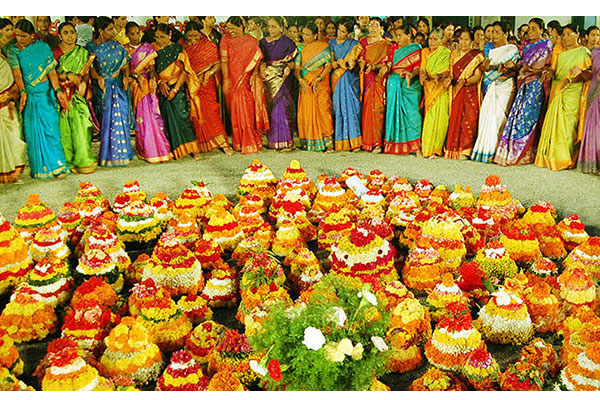
The Bathukamma festival has
several noteworthy features that even any region should emulate. It fosters a
spirit of community and collective consciousness as the villagers en masse
converge to sing and celebrate the festival. The themes in the Bathukamma songs
denote the rich cultural traditions and the struggle for life of the people.
The festival is also the celebration of womanhood as it is female centric .
Besides, the festival has lot of environmental importance too.
The colourful flowers attractively arranged in tiers provide a visual feast
besides purifying the air and water with their medicinal properties. Thus the
festival is not a demonstration of pomp and show but intimately attached to
nature . The inherent lesson the festival offers is to protect and preserve the
nature for the larger good of the humanity .

Flowers like Cassia, Celosia, Marigold, Chrysanthemum, Lotus,
Cucurbita leaves and others from uncultivated and barren plains of the region
are used to decorate the Bathukamma indicating the richness of life and
tradition.
It is widely believed that when hundreds of Bathukammas are
immersed in the water bodies like tanks , the concentration of the medical
properties increases in water leading to the death of bacteria, fungi and
protozoan’s. This helps in preventing water-borne diseases such as cholera,
typhoid and diarrhoea along with some skin diseases.
The Thangedu (Cassia auriculata )has antibacterial, anti-fungal
and antiprotozoal properties. Gunugu (Celosia argentea ) is useful in treating
jaundice, diarrhoea , gonorrhoea , wounds , fever and diabetes. Lotus (Tamera )
strengthens heart and helps in maintaining blood sugar levels .
Banthi(Marigold) is used in treatment of allergic reactions, eczema and bruises.
Chamanthi (Chrysanthemum ) helps in detoxification and clear vision.
However , this does not mean that these flowers should be
directly used. Further research is needed to study the significance and
scientific content of flowers used in the Bathukamma festival . But, the
festival practises tell us the immense value of nature and how humanity can be
benefited from it.

No comments:
Post a Comment